

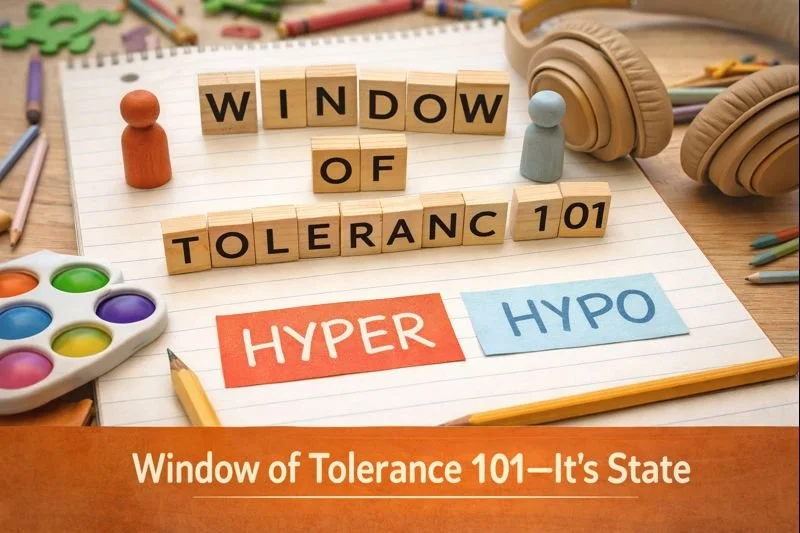
Hyper/Hypo Isn’t Attitude—It’s State (and how to build a shared pause-and-return plan)
On MLK Day, I often come back to this: a more regulated world is a more humane world. When we understand nervous systems, we stop moralizing stress responses—and we get better at creating safety.
If you’re parenting in a neurodivergent (ND) family, you’ve likely had a moment where your child is melting down or shutting down and a part of you wonders: Is this defiance? Is this attitude? And at the same time, another part of you knows: Something is happening in their body.
Here is the reframe that changes the whole room:
Hyperarousal and hypoarousal are not “attitude.” They are nervous system states.
And families tend to do better when they respond to state before they respond to behavior.
What the Window of Tolerance actually means
The Window of Tolerance is a practical way to understand capacity. When someone is inside their window, they usually have access to:
flexible thinking
emotional range without overwhelm
communication skills
problem-solving and perspective
relational connection
When someone moves outside their window, their nervous system shifts into protection mode. That’s not a flaw—it’s physiology.
For ND families, going outside the window can happen quickly because the load can be heavier: sensory input, transitions, demand overload, masking fatigue, social pressure, rejection sensitivity, disrupted sleep, chronic stress. These are not “excuses.” They are context.
Hyper and hypo: what they can look like at home
Outside the window often shows up in two broad patterns:
Hyperarousal (fight/flight):
This can look like urgency, argumentativeness, panic, agitation, snapping, pacing, rapid speech, “fix it now” energy, or escalating intensity.
Hypoarousal (freeze/shutdown):
This can look like numbing out, going quiet, blank stare, “I don’t care” (even if they do), collapsing on the bed, disappearing into a room, avoidance, or an inability to answer simple questions.
Both are “protective states.” Neither is a moral failing.
Why “hyper/hypo isn’t attitude” matters
When adults interpret a nervous system state as disrespect or manipulation, the usual response is to increase pressure: lecture, demand compliance, raise voice, remove privileges, push for eye contact, insist on immediate resolution.
But pressure on an already-overloaded system often creates more dysregulation. The cycle becomes:
adult escalates to gain control
child escalates or shuts down to survive
everyone feels unsafe and misunderstood
A more nervous-system-informed stance is:
Regulation first, then reasoning.
Not permissive. Not punitive. Protective and effective.
Step 1: Name your cues (everyone gets a “tell”)
A cue is the early signal that someone is leaving their window. The goal is not perfect self-awareness. The goal is earlier noticing.
Examples of hyper cues:
voice gets louder or faster
interrupting, arguing, “I have to fix this now”
clenched jaw, tight chest, restless body
tears that feel sudden or “too big”
Examples of hypo cues:
zoning out, going blank
slowed speech, “I don’t know,” “whatever”
looking sleepy or drained instantly
leaving the room, hiding, withdrawing
In an ND household, this step can feel surprisingly relieving. You’re not trying to diagnose each other. You’re building a shared language so the family can say: This is a state shift.
A practical way to do this:
Each family member chooses 2–3 cues.
Write them down (fridge note, phone note, family whiteboard).
Make it neutral. No teasing. No weaponizing.
Step 2: Build a shared pause-and-return plan
This is the “Uncomfortably Comfy” core: we do not force connection through overwhelm, and we also don’t disappear forever. We create a plan that protects safety and protects relationship.
A good plan has four parts:
1) A pause phrase (consistent words)
Pick language everyone understands:
“I’m outside my window. I need a pause.”
“My brain is overloaded. I’m taking a reset.”
Consistency matters. When the phrase is familiar, the nervous system recognizes it as a safety cue.
2) A reset action (short, concrete, sensory-friendly)
Choose 1–3 options that reliably help:
Orienting: look around and name 3 neutral objects
Feet + exhale: feet into the floor; exhale longer than inhale
Deep pressure: pillow squeeze, blanket, wall push
Temperature shift: cold water on wrists; hold a cool drink
Sensory break: dim lights, headphones, quiet corner
Keep it brief. The point is to come back toward the window, not to achieve perfect calm.
3) A return time (so nobody panics)
A clear time prevents “pause” from feeling like abandonment:
“I’ll come back in 10 minutes.”
“Let’s reset for 5 minutes and try again.”
For younger kids, an adult may stay nearby while reducing demands, helping the child borrow regulation.
4) A return script (repair and next step)
Return with a simple, non-lecture bridge:
“I’m back. I’m more inside my window.”
“Let’s try again.”
“What’s the next smallest step?”
What this builds over time
When families practice pause-and-return, they slowly create a new default:
less shame, more clarity
fewer power struggles, more co-regulation
earlier noticing, faster repair
more access to values like respect, kindness, and responsibility
That is mental wellness in a household: not never getting dysregulated, but knowing what to do when it happens.
Reflection
When you’re outside your window, do you tend toward hyper or hypo? What are your earliest cues?
Educational only; not therapy,
Educational only; not therapy.
