

When your child is melting down, they’re not giving you a hard time — they’re having a hard time.
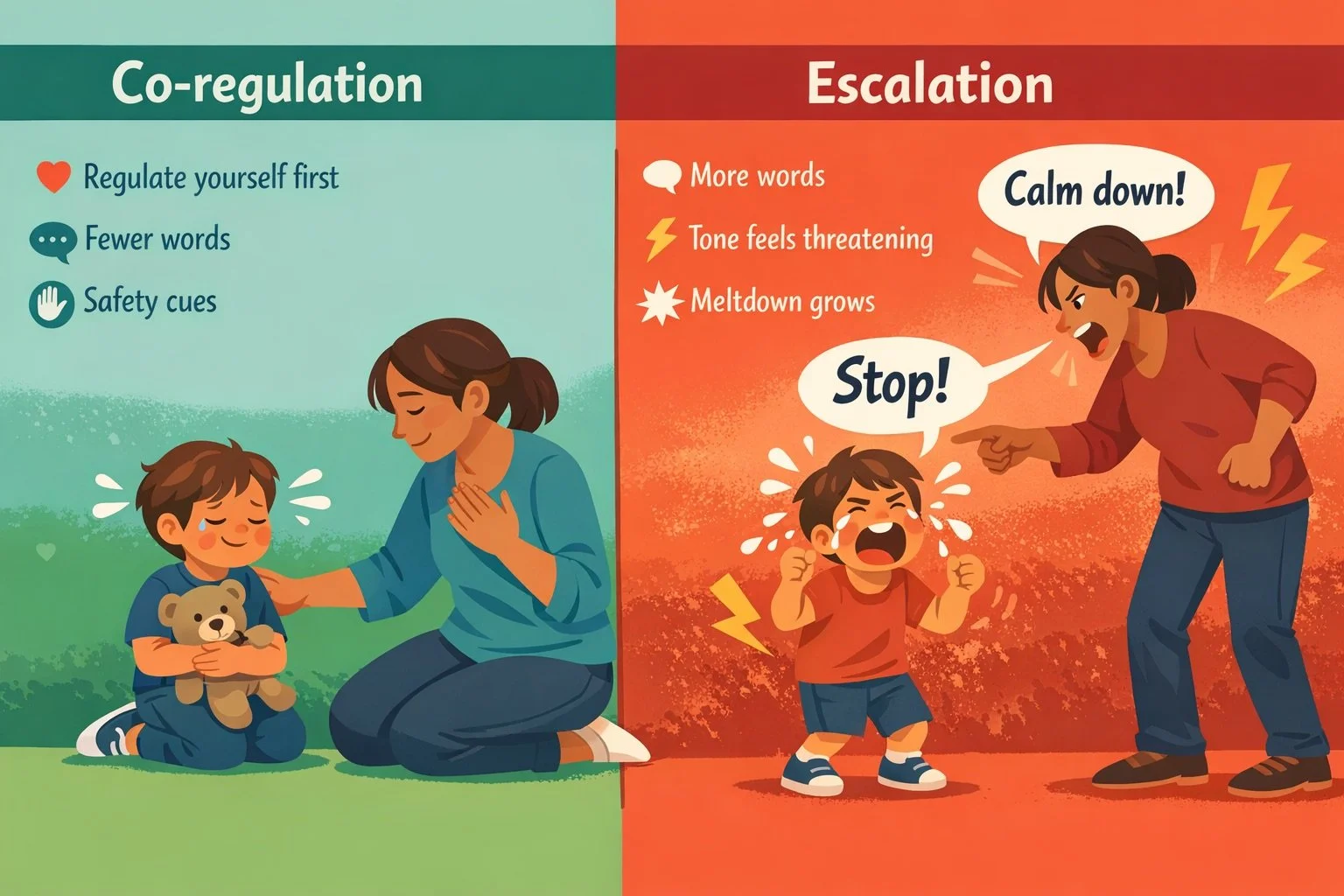
In those moments, their nervous system is in protection mode (fight/flight/freeze). Their body is flooded. Their “thinking brain” goes offline. What they need most isn’t a lecture or a solution… it’s a regulated adult nervous system to borrow.
That’s what co-regulation is:
Your calm voice, steady presence, and safe connection helping their body settle long enough for their brain to come back online.
Why “talking it through” can backfire in the moment
When kids are dysregulated, language gets messy:
They can’t take in long explanations.
Questions can feel like pressure (“Answer me!”) when their body is already overwhelmed.
Corrections can land as criticism, which can spike shame and escalate the storm.
The more we talk, the more they hear tone, not content.
So what sounds like “reason” to us can feel like threat to them — and misunderstanding turns into more yelling, tears, or shutdown.
What helps instead (connection before correction)
Try this simple sequence:
Regulate yourself first
One slow breath. Drop your shoulders. Unclench your jaw. Quiet your tone.
Connect with safety cues
Get low, soften your face, give space if needed.
Say less. Mean more.
Use short, steady phrases
“I’m here.”
“You’re safe.”
“This is hard.”
“We’ll talk when your body is calmer.”
“Let’s breathe together.”
Teach later (not during the fire)
When they’re calm, then you can problem-solve, repair, and set limits.
Co-regulation isn’t “letting it slide.”
It’s building the nervous system skills your child can’t access yet — so they can access them later.
If this is hard for you sometimes, you’re not failing. You’re human. Repair counts more than perfection.
Kids build self-regulation through relationship. Responsive, back-and-forth interactions with caregivers help shape brain architecture and support emotional and social development (often described as “serve and return”).
Emotion regulation is often a dyadic process. Children (and, at times, adolescents) may not yet have the neurobiological and cognitive capacity to regulate big emotions alone and rely on caregivers as an external resource while those systems mature.
Stress makes “thinking skills” harder to access. Under stress/arousal, the prefrontal cortex (important for executive functions like working memory, inhibition, and flexible thinking) becomes less effective — which is a big reason complex talking/lecturing can fail mid-meltdown.
Teens still need co-regulation, too. The teen years involve major “fine-tuning,” and the brain finishes maturing in the mid-to-late 20s; the prefrontal cortex is among the last areas to fully mature. Translation: they may look grown, but their regulation circuitry is still under construction.
Co-regulation is a defined, teachable parenting process. Harvard Health describes it as a warm, responsive, interactive process where adults stay regulated and support kids in learning emotional skills over time.
