

How Politics and the News Affect Mental Health: Regulating Your Nervous System and Navigating Difficult Conversations
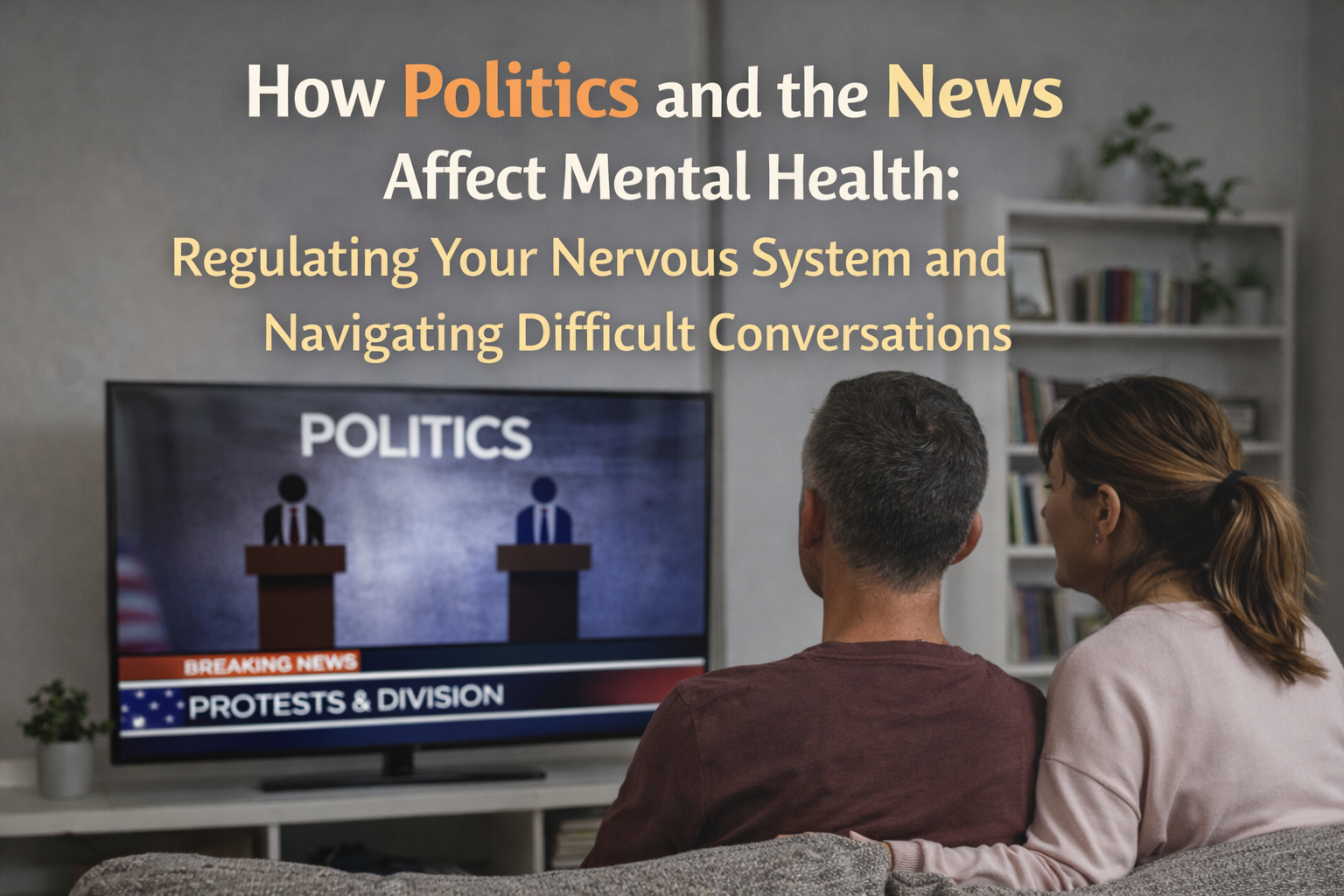
In today’s world, it can feel nearly impossible to escape the news cycle. Political headlines, social media debates, and constant updates can leave many people feeling overwhelmed, anxious, or emotionally drained.
Regardless of where someone falls politically, many individuals are experiencing similar emotional reactions: uncertainty, fear, frustration, and nervous system dysregulation.
From a mental health perspective, these reactions are not unusual. In fact, they are deeply connected to how our brains and bodies respond to perceived threats and uncertainty.
Understanding the connection between politics, stress, and relationships can help us care for our mental health while still staying informed and engaged.
Why the News and Politics Can Feel So Stressful
Our brains are wired to constantly scan the environment for danger. When we are repeatedly exposed to emotionally charged content—conflict, crisis, uncertainty, and strong opinions—our nervous system may interpret this as a signal that something is wrong.
This can activate the body’s stress response system, which includes the well-known fight, flight, or freeze reactions.
When this happens, people may notice symptoms such as:
Increased anxiety or worry
Irritability or emotional reactivity
Trouble sleeping
Feeling overwhelmed or mentally exhausted
Difficulty concentrating
A sense of helplessness about the future
When the news cycle runs continuously, the nervous system may not get the opportunity to fully reset. Over time, this can lead to chronic stress and emotional fatigue.
The Impact of Political Stress on Relationships
Another major area affected by political polarization is relationships.
For many people, political beliefs are closely tied to personal values and identity. When conversations about politics arise with friends, family members, or coworkers who hold different views, discussions can quickly become emotionally charged.
This can create tension in relationships and lead to:
Avoiding certain topics or gatherings
Feeling misunderstood or judged
Increased conflict with loved ones
Emotional distance within families or friendships
However, relationships can also be powerful spaces for understanding and regulation. When people feel heard and respected, even when they disagree, conversations become less threatening to the nervous system.
The goal of these conversations does not have to be agreement. Instead, the goal can be maintaining connection and psychological safety.
The Nervous System and Difficult Conversations
When a conversation begins to feel heated or confrontational, it is often because the nervous system has moved into a defensive state.
When this happens, the brain shifts into protection mode. People may:
Interrupt or argue more strongly
Try to convince or prove a point
Shut down or withdraw from the conversation
Label or criticize others
These responses are natural when the nervous system perceives a threat.
However, when people are more regulated, they are more capable of:
Listening
Reflecting
Staying curious
Holding complex perspectives
Learning how to regulate the nervous system can make a significant difference in how these conversations unfold.
How to Protect Your Mental Health During Political Stress
While we cannot control the news cycle or the opinions of others, we can take steps to care for our mental health and nervous system.
Below are several therapist-recommended strategies.
1. Set Boundaries Around News Consumption
Constant exposure to political content can keep the brain in a state of alert.
Consider:
Checking the news once or twice per day instead of continuously
Avoiding social media debates that escalate stress
Turning off news notifications when possible
Giving your mind breaks from the news allows your nervous system to reset and recover.
2. Reset Your Nervous System
Regulation often starts with the body.
Simple practices that can calm the nervous system include:
Slow, deep breathing
Walking outside or spending time in nature
Stretching or gentle movement
Noticing sensory details around you (sights, sounds, textures)
These practices help signal to the brain that you are safe in the present moment.
3. Approach Conversations with Curiosity
When discussing politics with others, shifting the goal from convincing to understanding can change the entire tone of the conversation.
Instead of trying to change someone’s mind, consider asking questions such as:
“What experiences shaped that perspective for you?”
“What concerns feel most important to you about that issue?”
Curiosity creates space for dialogue instead of debate.
4. Focus on Shared Human Values
Even when people disagree on solutions, many individuals share common values, such as:
Safety
Stability
Protecting loved ones
Hope for the future
Recognizing these shared motivations can reduce defensiveness and increase empathy in conversations.
5. Know When to Take a Break
Sometimes the healthiest choice is to step away from a conversation or topic.
Taking space does not mean you do not care. It simply means you are prioritizing emotional regulation and mental health.
You can return to conversations later when everyone feels calmer and more grounded.
Finding Balance in a Divided World
We are living in a time where political conversations can feel intense and deeply personal. The constant flow of information and opinions can leave many people feeling emotionally overwhelmed.
But beneath the debates and headlines are human nervous systems trying to feel safe and understood.
When we take time to regulate ourselves, set boundaries around information, and approach conversations with curiosity and compassion, we create space for something important:
More understanding.
More emotional resilience.
And stronger relationships—even in the midst of differences.
Staying informed matters.
But so does caring for your mental health.
Both can exist at the same time.
