

Am I supporting my partner… or am I enabling them?
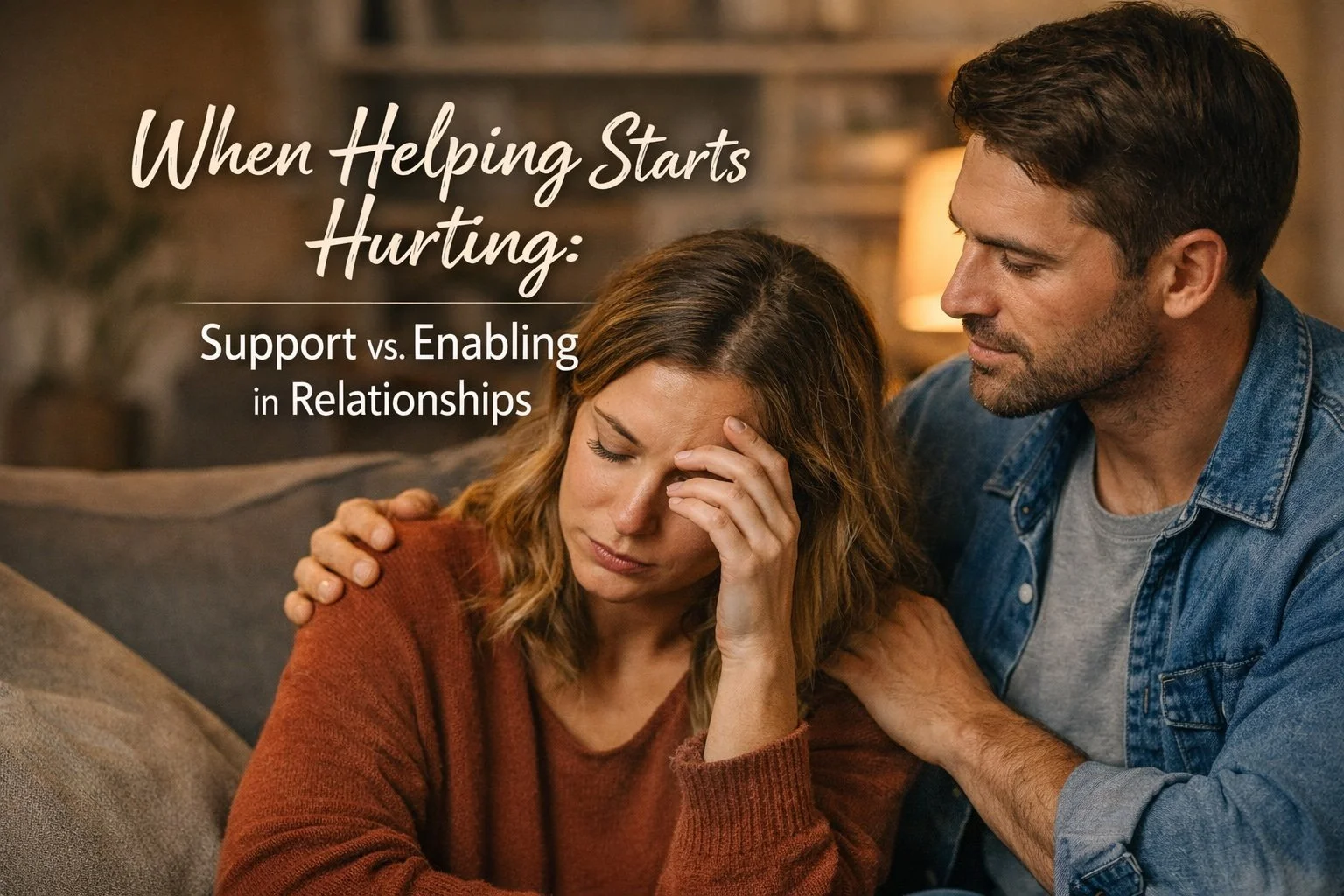
There’s a quiet, often painful question that lives inside many relationships: Am I supporting my partner… or am I enabling them? It’s rarely a clean line. More often, it’s something we feel in our bodies before we can name it—an exhaustion that lingers, a resentment we try to soften, or a sense that we’re carrying more than what feels shared.
From an attachment lens, our instinct to support the people we love is deeply human. When our partner is struggling, our nervous system naturally moves toward them—we want to soothe, protect, and stabilize the bond. Supporting a partner can look like showing up with empathy, holding space for their emotions, and offering help without losing sight of their agency. It says, “I’m here with you, and I trust your capacity to move through this.” There is a sense of connection without over-functioning.
Enabling, however, often begins from the same loving place—but shifts subtly over time. It can emerge when our partner’s distress feels intolerable to us, and we begin to manage, fix, or compensate in ways that relieve immediate discomfort but unintentionally reinforce stuck patterns. Instead of standing beside them, we may find ourselves stepping in front—taking responsibility for what isn’t ours to carry. The relationship can begin to organize itself around avoiding discomfort rather than growing through it.
Emotionally, the difference often shows up in what’s happening beneath the surface. Support tends to feel grounded and connected, even when it’s hard. There’s room for both partners to exist fully. Enabling, on the other hand, can feel like walking on eggshells, overextending, or silencing parts of yourself to keep the peace. You might notice thoughts like, “If I don’t do this, everything will fall apart,” or “It’s just easier if I handle it.” Over time, this can erode trust—not only in your partner’s ability to cope, but in your own needs being seen and valued.
Relationally, enabling often creates an imbalance in the attachment dynamic. One partner becomes the over-functioner, the stabilizer, the emotional manager. The other may, unintentionally, become more dependent or avoidant of responsibility. Neither role is inherently “wrong”—they’re adaptations, often shaped by each person’s attachment history—but they can lock couples into cycles where growth feels out of reach.
Supporting, in contrast, invites mutuality. It allows space for discomfort, accountability, and repair. It might sound like, “I care about you deeply, and I also believe you can take steps here,” or “I’m here to support you, but I can’t do this for you.” There is a gentle boundary that protects both connection and individuality. In emotionally focused terms, it keeps the bond secure while still allowing each partner to engage with their own inner world.
One of the most important questions to ask yourself is not just what you’re doing, but why. Are you stepping in because your partner truly needs temporary support, or because their discomfort activates something in you that feels unbearable? Are you helping in a way that moves the relationship forward, or in a way that keeps both of you in the same place?
There’s also compassion needed here. Many people who lean toward enabling have learned, at some point, that love means self-sacrifice, over-giving, or earning connection through caretaking. Shifting this pattern isn’t about becoming less loving—it’s about becoming more honest. More attuned. More willing to tolerate the tension that comes with letting your partner struggle while still staying emotionally present.
Healthy support doesn’t remove struggle—it transforms how it’s held. It says, “You don’t have to go through this alone, but you do have to go through it.” And in that space, something powerful can happen: both partners grow, not just in their individual capacities, but in their trust that the relationship can hold truth, discomfort, and change.
The line between enabling and supporting isn’t fixed. It’s something we continuously navigate, moment by moment, relationship by relationship. And often, the most meaningful shifts don’t come from doing more—but from doing differently, with intention, awareness, and a willingness to stay connected without losing yourself in the process.
