

Skepticism, Hypervigilance, and the Nervous System: When Protection Starts Running the Show
Skepticism is not always negativity, and hypervigilance is not always overreacting. Sometimes both are the nervous system’s way of saying, “I need more information before I feel safe.” For many people with trauma histories, first responders, and neurodivergent nervous systems, skepticism and hypervigilance become deeply wired survival strategies. They show up in relationships, work, parenting, conflict, intimacy, rest, and even in moments that are technically safe. While these patterns can feel exhausting or misunderstood, they often began as protection. The work is not to shame them away. The work is to understand them, soften them, and learn when they are helping — and when they are keeping us stuck.
Hypervigilance is a heightened state of alertness. It is when the brain and body are constantly scanning for danger, changes, tone shifts, facial expressions, mistakes, rejection, conflict, or signs that something might go wrong. It can sound like, “I can’t relax,” “I feel like I’m always waiting for the other shoe to drop,” or “I notice everything.” Skepticism is the questioning part. It may sound like, “Are they really being honest?” “What do they actually mean?” or “This feels too good to be true.” These responses are not character flaws. For many people, they are learned forms of protection. If trusting too quickly once led to pain, betrayal, danger, rejection, or overwhelm, the brain may decide that trusting slowly — or not at all — feels safer.
Trauma changes the way the nervous system experiences safety. When someone has lived through emotional neglect, abuse, betrayal, chaos, violence, abandonment, high-conflict relationships, or unpredictable caregiving, the body may learn that danger can come at any time. So the brain starts scanning. It watches tone, reads facial expressions, tracks mood changes, remembers patterns, prepares for conflict, and anticipates disappointment. In unsafe environments, this can be incredibly adaptive. It may have helped someone survive, stay ready, avoid conflict, or protect themselves emotionally. The challenge is that the nervous system does not always update itself when life becomes safer. So even when the threat is gone, the body may still live like it is coming.
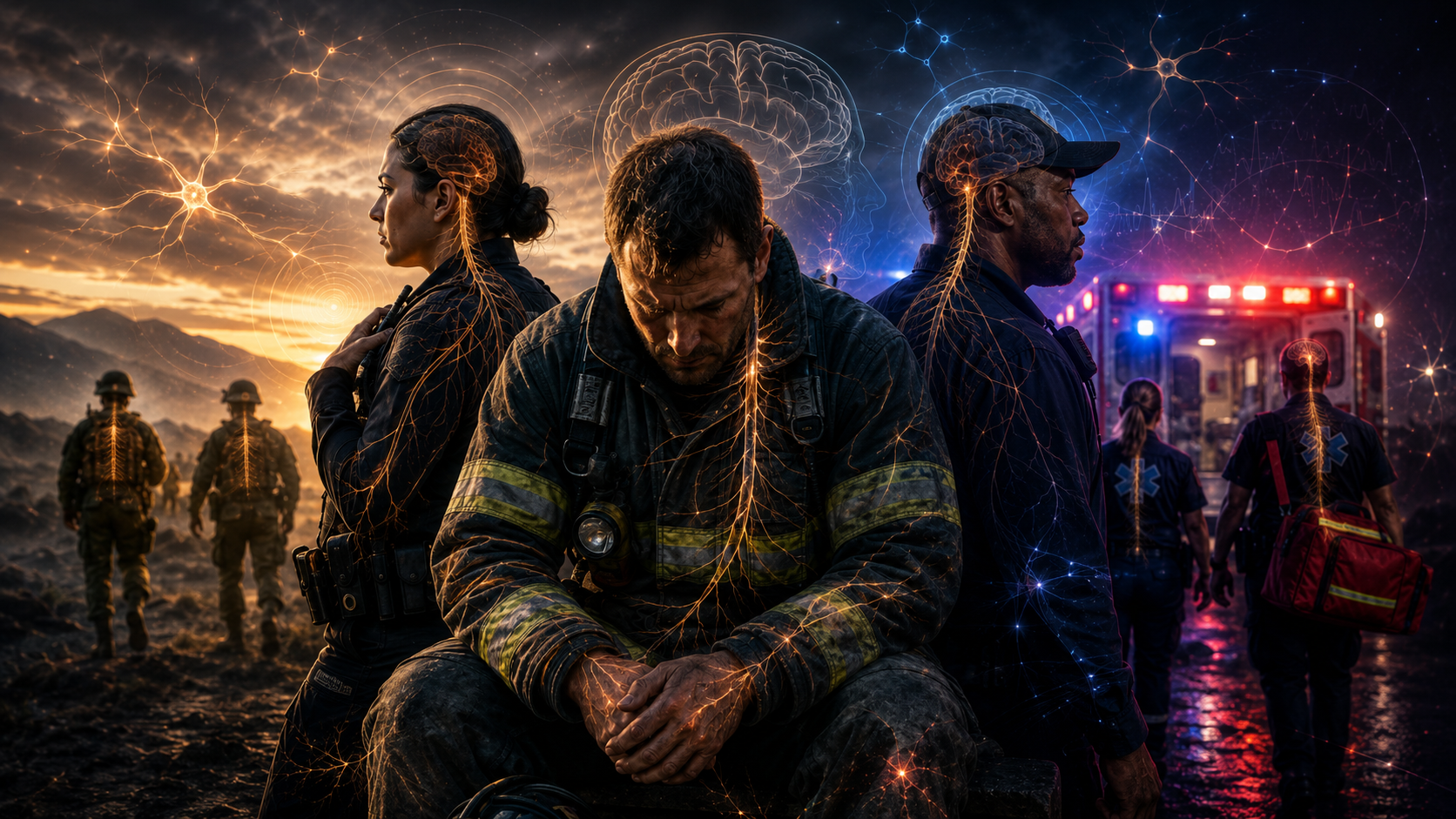
For first responders, this pattern can be especially complicated because alertness is often part of the job. Police officers, firefighters, EMTs, paramedics, dispatchers, correctional officers, medical workers, military personnel, and crisis workers are trained to assess risk quickly. Their brains are shaped by repeated exposure to emergencies, danger, unpredictability, trauma, and human suffering. In the field, hypervigilance can be life-saving. It helps them notice details others miss, anticipate danger, stay prepared, and move into action when others freeze. But when the shift ends, the nervous system may not know how to clock out. At home, this can look like difficulty relaxing, needing control over the environment, feeling irritated by noise or chaos, scanning crowds and exits, sitting where they can see the door, struggling with vulnerability, or feeling disconnected from loved ones. Many first responders are not cold or emotionless. They are carrying bodies that had to become very good at functioning under pressure. The problem is not the survival skill. The problem is when survival mode becomes the only mode.
For neurodivergent people, including those with ADHD, autism, sensory processing differences, or other forms of neurodivergence, skepticism and hypervigilance can also show up in unique ways. Many neurodivergent people have spent years being misunderstood, corrected, criticized, excluded, overstimulated, or told they were “too much,” “not enough,” “lazy,” “dramatic,” “rude,” “sensitive,” or “not trying hard enough.” Over time, the nervous system may begin scanning for rejection, judgment, tone shifts, sensory threats, social mistakes, or signs that someone is upset. This can look like replaying conversations, worrying you said the wrong thing, reading into texts or facial expressions, masking to avoid judgment, needing predictability, becoming overwhelmed by sudden changes, or feeling skeptical when people offer praise or kindness. For autistic individuals, the world can feel unpredictable, loud, fast, socially confusing, and sensory-heavy. For ADHD brains, hypervigilance may show up around mistakes, rejection sensitivity, emotional intensity, unfinished tasks, or constantly trying to catch up before something falls apart. When trauma and neurodivergence overlap, the nervous system may carry both sensory sensitivity and survival sensitivity. That is a lot for one body to hold.
Skepticism and hypervigilance are not bad. They become painful when they start running the entire system. They can make it hard to trust safe people, receive love, ask for help, relax into calm, believe things can change, stay present during conflict, repair after disconnection, or communicate needs without defensiveness. When someone is hypervigilant, they may not be responding only to what is happening in the present moment. They may be responding to what their body fears is about to happen based on the past. This is why telling someone to “just calm down” rarely works. Their body does not need shame. Their body needs safety, repetition, and new experiences that teach, “This moment is different.”
At Uncomfortably Comfy, we believe change often begins in the places we want to avoid. The guarded places. The skeptical places. The reactive places. The places where the nervous system says, “Nope, I am not going there.” But healing does not mean forcing yourself to trust everyone, relax instantly, or ignore your instincts. Healing means learning to pause and ask, “Is this my intuition, or is this my protection?” “Is this happening now, or is my body remembering then?” “Is this person unsafe, or does closeness feel unsafe?” “Am I responding to the present, or preparing for an old pattern?” That pause is powerful because it creates choice. And choice is where change begins.
One way to lean into skepticism and hypervigilance is to name it without shaming it. Instead of saying, “I’m crazy,” “I’m dramatic,” or “I’m too much,” we can say, “My nervous system is scanning right now,” or “A protective part of me is activated.” This helps create space between who we are and what we are experiencing. We are not the hypervigilance. We are noticing the hypervigilance. Another way to work with it is to gently check the evidence. Skepticism often wants certainty, but healing often requires curiosity. We can ask, “What facts do I actually have?” “What story is my brain adding?” “What else could be true?” “Does this situation remind me of something old?” This is not about gaslighting ourselves. It is about giving the nervous system more information before reacting.
Because hypervigilance lives in the body, not just the mind, we also have to bring the body into the present. This can be as simple as feeling your feet on the floor, looking around the room and naming what you see, taking a slower exhale, placing a hand on your chest or stomach, or reminding yourself, “I am here. This is now. I am not back there.” The goal is not instant calm. The goal is helping the body locate the present. In relationships, it can also help to communicate the pattern instead of acting from it. Rather than leading with defensiveness, withdrawal, control, or accusation, we can say, “I notice I’m getting activated and my brain is filling in blanks,” or “I want to trust you, but something in me is feeling guarded,” or “I need a minute to regulate before I respond.” This creates connection instead of conflict.
A hypervigilant nervous system does not usually soften because of one big conversation. It softens through repetition. Safe people showing up consistently. Boundaries being respected. Repair happening after conflict. Needs being heard. The body learning, over and over again, that not every mistake leads to abandonment, not every disagreement leads to danger, and not every calm moment has to be mistrusted. Consistency heals what chaos trained. Over time, the work becomes learning the difference between intuition and trauma response. Intuition is often calm, clear, and grounded. Trauma response is often urgent, panicked, loud, and absolute. Intuition may say, “Something feels off. Pay attention.” Trauma may say, “You are not safe. Everything is about to fall apart. React now.” Both deserve attention, but they do not always need the same response.
Growth does not mean becoming less protective. It does not mean becoming naive, trusting everyone, or shutting off the part of you that helped you survive. Growth means learning how to update your protection. It means learning, “I can be aware without being consumed. I can be cautious without being closed. I can ask questions without attacking. I can set boundaries without disconnecting. I can trust slowly. I can let safe people in. I can rest. I can repair. I can choose connection without abandoning myself.”
If you are skeptical, guarded, or hypervigilant, there is probably a reason. Your body may have learned to protect you before you had the words, support, or safety to understand what was happening. So we do not start with shame. We start with compassion. Then curiosity. Then choice. And slowly, we begin leaning into the uncomfortably comfy places where protection can become awareness, awareness can become growth, and growth can create deeper connection with ourselves and the people we love.
