

Neurodivergent, Not Broken: The Uncomfortably Comfy Guide to Understanding Your Brain
Neurodivergence 101: Why It Matters (and Why “Trying Harder” Isn’t the Answer)
If you’ve ever thought, “Why is this so hard for me (or my kid) when it seems easy for everyone else?”—you’re not alone. Many individuals and families come to therapy or coaching carrying a quiet shame story: I should be able to handle this.
At Uncomfortably Comfy, we start somewhere different.
We start with this: Your nervous system is doing its best to keep you safe. And for neurodivergent brains, the “rules” of the world often ask for constant adaptation—sometimes at a cost.
What does “neurodivergence” mean?
Neurodivergence is an umbrella term that describes brains that process, learn, sense, and regulate differently from what society labels “typical.” That can include ADHD, autism, learning differences, sensory processing differences, OCD, and more.
Important: neurodivergence is not a character flaw. It’s not laziness. It’s not a lack of willpower.
It’s a different operating system.
Why is this an important topic right now?
Because more people are recognizing themselves (or their kids) in the language of neurodivergence—and realizing that shame-based explanations never actually helped.
We also have growing public-health visibility. For example, the CDC estimates that about 1 in 31 8-year-old children have been identified with autism through its monitoring network. That number doesn’t tell the whole story, but it does underscore why families, schools, and healthcare systems are paying closer attention.
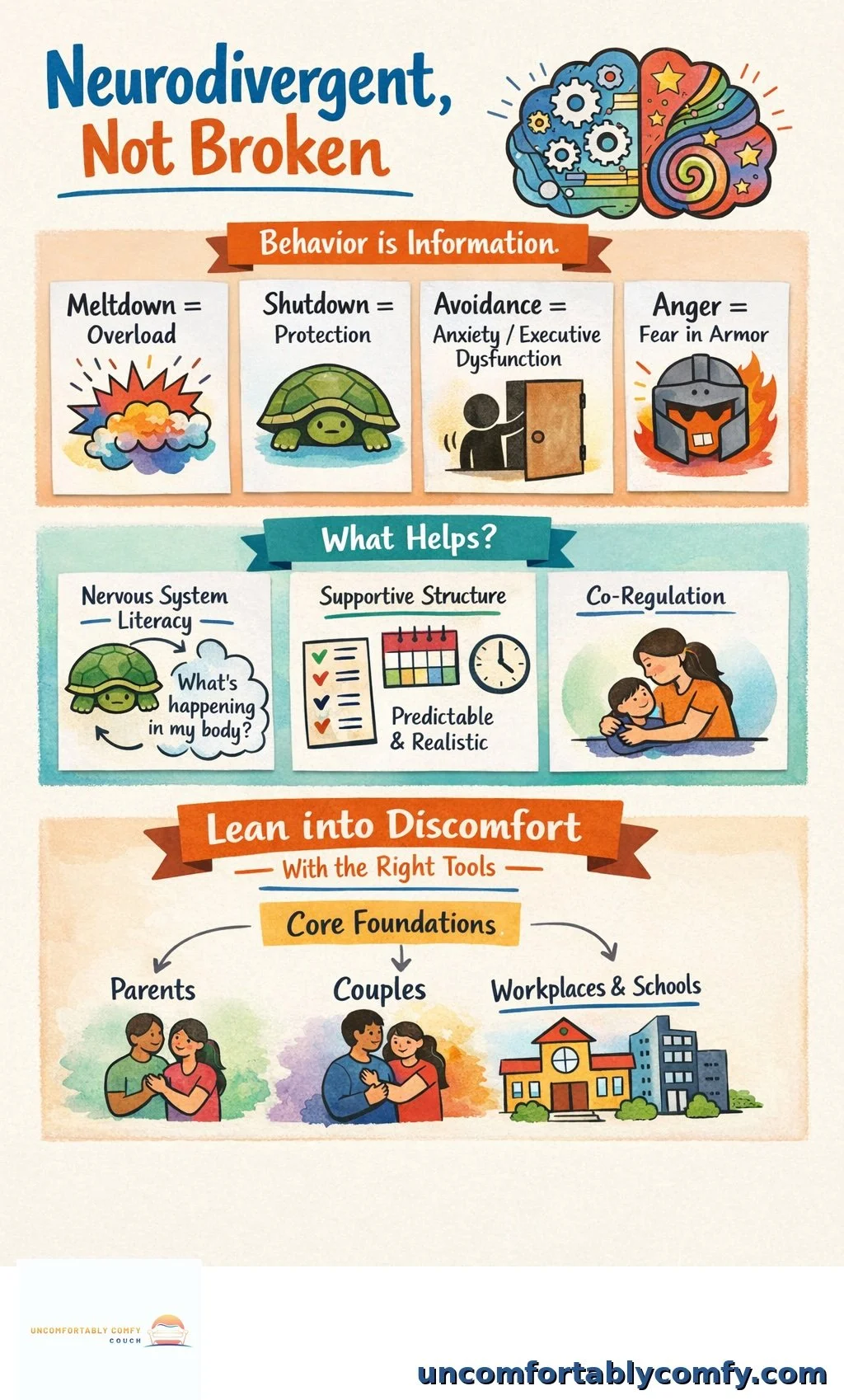
The Uncomfortably Comfy reframe: behavior is information
One of the biggest shifts is moving from:
“How do we stop this behavior?”
to“What is this behavior communicating about the nervous system, sensory load, overwhelm, or unmet needs?”
This matters because a lot of “problem behavior” is actually a stress response:
Meltdowns can be overload.
Shutdown can be protection.
Avoidance can be anxiety—or executive dysfunction—or both.
Anger can be fear wearing armor.
When we mislabel what’s happening, we apply the wrong solution. And then everyone feels worse.
Common signs (in real-life language)
People often seek support for:
Executive functioning differences: getting started, organizing, time awareness, follow-through.
Emotional intensity: big feelings that spike fast and take longer to settle.
Sensory overwhelm: noise, lights, clothing, transitions, crowded spaces.
Social fatigue or masking: seeming “fine” externally while burning out internally.
Frequent misunderstandings: especially in families and relationships.
None of these mean someone is “too much.” They often mean someone is overloaded.
What actually helps (evidence-based, practical, and humane)
Support works best when it reduces shame and increases clarity.
Here are four starting points that are both compassionate and effective:
1) Build nervous-system literacy
Instead of asking “What’s wrong with you?” try:
“What’s happening in your body right now?”
“What signs show you’re getting overloaded?”
“What helps you come back to baseline?”
This is why our trainings begin with Core Foundations—because skills land better when you understand the nervous system first.
2) Use structure as support, not punishment
Neurodivergent-friendly structure is:
visible (lists/visual cues),
predictable (routines with flexibility),
and realistic (built for real life, not ideal life).
Structure should reduce cognitive load—not add another place to fail.
3) Prioritize co-regulation (especially with kids and teens)
Many families are told to “be consistent” when what they really need is co-regulation—an adult who can stay grounded enough to help the child borrow calm.
This is also why evidence-based parent supports matter. The CDC highlights parent training in behavior management as a recommended approach for helping children with ADHD-related challenges. (In practice, the best versions of this are nervous-system aware, relationship-centered, and shame-free.)
4) Make room for identity (and grief)
Sometimes the “discomfort” is not the symptoms. It’s the grief:
grief over missed supports,
grief over years of masking,
grief over being misunderstood.
Leaning into discomfort here is not about pushing harder. It’s about letting the truth be true—so you can build a life that actually fits.
If you’re wondering, “What now?”
Here are two next steps that match where many people are:
If you’re a parent of a neurodivergent (or possibly neurodivergent) child:
Look for supports that help you read behavior through a sensory + nervous-system lens, reduce shame cycles, and build home systems that work. That’s the heart of Neurodivergent Kids, Safer Homes in the trainings.If you’re a teen or adult who suspects ADHD/autism (or already knows):
Therapy/coaching can focus on emotional regulation, executive functioning, communication, self-advocacy, and routines that fit your neurotype—not forcing you to “fit the mold.”
The Uncomfortably Comfy takeaway
The goal isn’t comfort.
The goal is capacity:
capacity to name what’s happening,
capacity to ask for what helps,
capacity to repair relationships after hard moments,
capacity to live in a brain that is different without living in shame.
If you’re ready to start, Contact us to learn more or book a free consultation appointment.
In the meantime lean into the areas of Discomfort for Change, Growth, and Connection.
